
SEA URCHIN KNOWLEDGE BASE 51126


SEA URCHIN KNOWLEDGE BASE 51126
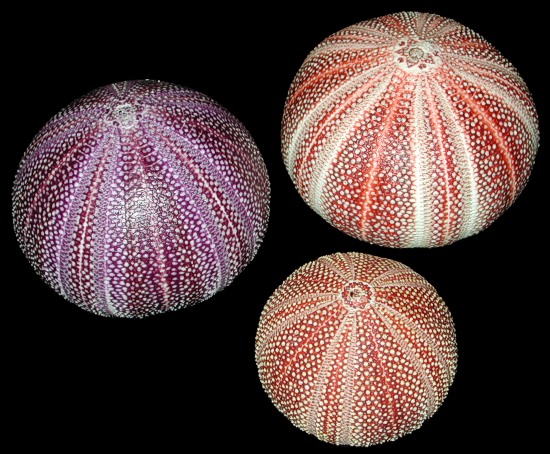
ENGLISH CHANNEL SEA URCHINS
The English Channel Urchins, as well as other sea urchins belong to the class Enchinoidea. Scientific name. Eichinus esculents. This is the same group of water based animals that include the sand dollars. These creatures do not have arms. They have movable spines that can swing in any direction.
- These creatures have tube feet arranged in 5 pairs extending around the body. The feet are tipped with suckers that reach behond the spines.
- Around the urchin's mouth are tube feet that can attach to its food. The tube feet draws the urchin's mouth to its food and feeds by gnawing with teeth called "Aristole's Lantern". This structure consists of 5 teeth.
- Aristotle's Latern is not developed well in urchins. They primarily feed on plankton and organic particles trapped on mucus.
- English Channel Urchins are found in the eastern Atlantic and along the eastern Pacific coast ranging from Alaska south to the tip of Baha California.
- English Channel Urchins are sought by Orientals for the eggs. The urchin eggs are collected thru the bottom of the urchin. You will notice the bottom opening of the English Channel Urchin. This opening is often used to convert the carcass into a lamp (which we offer).
- Tne Alfonso Urchin is popular for its markings. It has a chalky design decorating a green background. It appears that the chalkiness is more pronounced in the more mature urchins, giving the look of being covered by powder. These specimen are from the Indo-Pacific rim: which ranges from the Western Indian Ocean to the Sea of Japan and Northern Australian shores to the East.
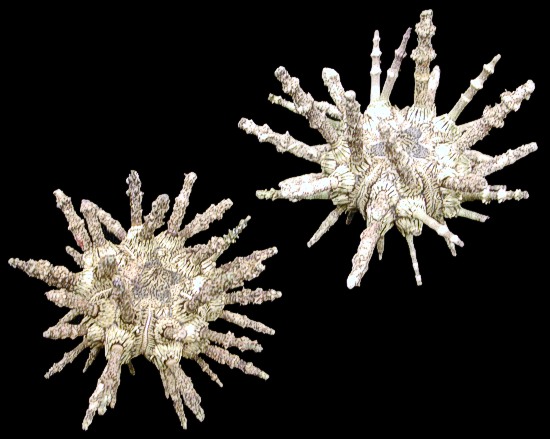
The Imperial Sea Urchin, scientifically known as Phyllacanthus imperialis, belongs to the Cidaridae family. It is also referred to by various names including Imperial Urchin, Pencil Urchin, Lance Urchin, Sputnik Urchin, and several others such as Knobby Sputnik and Land Mine Sea Urchin.
The entire sea urchin, including its spines, is considered part of the organism; some of these spines may be loosely attached and can easily detach.
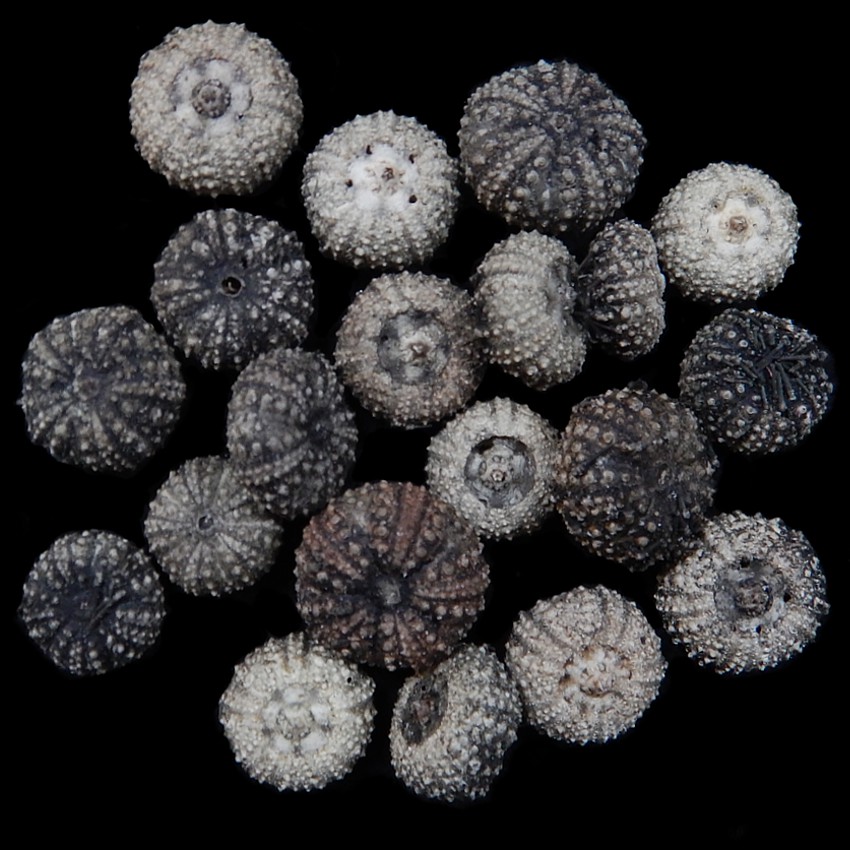
Baby Black Urchins
Diadema antillarum, commonly referred to as the lime urchin, black sea urchin, or long-spined sea urchin, belongs to the sea urchin species within the Diadematidae family.
These Sea urchins are the most abundant and significant herbivores in the coral reefs of the western Atlantic and Caribbean basin. At healthy population levels, they serve as the primary grazers that prevent the overgrowth of algae on the reefs.
Diadema antillarum has a "shell," similar to most other sea urchins. What distinguishes the Diadema is the length of its spines. Most sea urchin spines are 1/3 to 1.25 inches, but the spines in this species are usually 4 to inches length, and can grow as long as 12 inches on very large individuals.
This species typically resides at depths of 3.25 to 33 feet within coral reefs. They frequently embed themselves within crevices, leaving only their spines visible, while those unable to find a crevice inhabit more open areas. Urchins that secure a crevice tend to forage up to 4 feet away from it at night. Diademas, highly sensitive to light, often select their crevices or resting spots based on the available shade..
Diademas primarily consume algae and occasionally seagrass. In times of scarcity, these urchins have been observed adopting carnivorous behavior.
Diademas are located in the tropical Western Atlantic, encompassing the Caribbean Sea, Gulf of Mexico, and the northern and eastern shores of South America, extending as far south as Brazil. They are also present in the Eastern Atlantic near the Canary Islands and throughout the Indian Ocean. Ecologically significant, this species feeds on algae which, if left unchecked, could overgrow and suffocate coral reefs. Their habitat includes the crevices within the reef structure.
Scientific classification
Domain: Eukaryota
Kingdom: Animalia
Phylum: Echinodermata
Class: Echinoidea
Order: Diadematoida
Family: Diadematidae
Genus: Diadema
Species: Diadema antillarum
Binomial name: Diadema antillarum
(Philippi, 1845)
(REF: Kroh, Andreas (2013). Kroh A, Mooi R (eds.). "Diadema antillarum Philippi, 1845". World Echinoidea Database. World Register of Marine Species.)(REF: Farland, K. Clay. Wood, James B. (ed.). "Long-spined Sea Urchin". Marine Invertebrates of Bermuda. Retrieved 2 June 2023)(REF: Osborne, Patrick L. (2000). Tropical Ecosystem and Ecological Concepts. Cambridge: Cambridge University Press.)